
We had an opportunity to spend some time with Romi Hall to talk about the long arc of change, the urgent timetables of community development work, and what Black futurism and Donella Meadows’ iceberg model tell us about building a sector that can support anti-racist work for the long haul.
Can you share a bit about your work in community development? How did you get into the sector?
Romi: Funny thing, now I realize my start in community development really happened while I was getting my master’s in public health over 15 years ago. I have actually always been working at the intersection of health, housing, and community development – it wasn’t really understood as an intersection when I started my career in community development.
While in graduate school, I had the opportunity to intern with a faith-based organization who was creating respite spaces in places of worship for unhoused individuals in Philadelphia. Through building relationships and hearing stories of the Welcome Church members, I started to understand the social determinants of health and wanted to create thriving communities for all. This internship piqued my interest to work in housing and comprehensive community development (CCD), and led to my first job out of graduate school working at a venerable community development corporation in St. Louis. I worked on a massive CCD initiative where a team of colleagues and I spent a year deeply engaging residents. We created a dynamic action plan based on the specific asks of residents and with cross-sector partners, the school district, municipal leaders, and residents to make the bold vision of the plan a reality. After this experience, I went to another community development corporation in Oakland that affirmed my interest and passion of working at the intersection.
Throughout my experience in community development, it has always been hard to name what I do. Collective Impact articles, the Federal Reserve Bank of San Francisco’s working papers on health and housing, and articles about being a community quarterback helped me gain clarity that the work I do is valuable and important in creating thriving communities. I honestly often pinch myself because the career that I have had has been incredibly formative and provided profound insights and a strong belief that anything is possible.
A lot of people we interviewed in our anti-racist community development research felt that the sector needs to do more of this big picture, intersectional work. Have you had that experience?
Romi: Yes, and we also need to embrace adaptivity and transformation. The work of anti-racist community development will not be won by solutions that solely focus on the implementation of programs and services, increasing capital access, and partnership. These are important ingredients, but just crack the surface. The work we need to do to get to the big picture and intersectional aspect of our work is to restructure our mental models individually and collectively so we can reshape the system we currently function in for the tomorrow we want that generates opportunity. This is more than the quick timetables and timelines our work in community development often works on.
Arguably, the urgency, the quick timetables, the quick turnarounds, they are essential to the work, but so is the longevity and marathon-running aspect of this work. How do people keep that sense of longevity while doing the day-to-day community development work?
Romi: It is really hard. The quick deadlines and timelines are always coming, they just do not stop – how I wish they would. What I have learned through my mentors in this field, with other housing and community development leaders across the country, and in fellowship opportunities, is that having a results orientation matters. I have particularly understood this more with becoming a parent as I partner with my husband to raise our son into a kind, inclusive, and thoughtful human being. We have centered who he is and what he needs as we spend time with him, take him on adventures, create space for conversations and vulnerability, discipline him with love, and talk about the hurts of the world and how we can work to fix them. Every day in parenting there are quick turnarounds and deadlines, though our big picture is clear. While he is still becoming, we see glimpses of our son achieving this result that encourages us to continue to keep going. And, we’re also witnessing our son be empowered and achieve the result on his own, too.
Results are powerful. They are manifestations of ideas, dreams, and capabilities that offer profound insight into a new future. Results are what can keep our focus in the short and long term and makes clear the work that needs to happen. Having clear results can be a compass to navigate the different terrains, valleys, and mountains that are inevitably a part of the journey. I am acutely aware of how I experience this long and short view together as a parent, and how important holding both of these views are key to advancing anti-racist work.
In anti-racist community development, the results call us to center Black and brown people, actively engage Black and brown people in every part of the process and build deep trust through achieving results. To do this, our calculus toward work has to change as we need to hold both what is in front of us now and what could be in the future, weaving and stitching together the possibilities and opportunities to get there. We also need to recognize that we need true, trusting partnerships to do this work, and to have deep compassion for ourselves and others as we make mistakes and grieve what is not, trusting that what we do will contribute to what could be.
That’s a great reminder to folks to be able to really ground themselves and not immediately jump to the impulse for action. Can you share some examples where you are currently seeing people doing that bigger picture anti-racist community development? Are these examples replicable or unique?
Romi: Action is really important. I cannot stress this enough. Though actions can be detrimental to communities if they are not clear on the why or steeped in community voice and vision. I can think of a number of examples across the country where good, transformational work is happening – though, what I am struck by in these questions are the words “replicable” and “unique.” I am thinking differently about the examples and really thinking about the frameworks that can influence replication and uniqueness to advance anti-racist community development.
To this end, Donella Meadows’ Iceberg Model comes to mind and makes me wonder how we can replicate actions beyond what we see and experience as anti-racist community development to go much deeper to leverage our collective actions to influence systems and structures and generate new dynamic narratives about Black and brown communities. I have also been really interested in futurism, particularly Black futurism. In 2019, I had the opportunity to briefly support Walter Hood’s Black Towers/Black Power. 2020 as part of the Museum of Modern Art’s (MOMA) Reconstructions: Architecture and Blackness in America exhibition. As part of Mr. Hood’s exhibit, he explores a new future in the historically Black community of West Oakland. Inspired by the vision of the Black Panthers’ Ten-Point Program, Mr. Hood recreates a new vision of an existing divested corridor in Oakland with high-rise buildings, art, commerce, and more.
Mr. Hood envisions a thriving community based on the collective voice of Black people. His work is provocative and dares for the viewer to reimagine what is possible, because “it has been really hard for Brown and Black people to imagine a future (…) and maybe it’s possible to re-imagine ourselves in new places and then find ways to get there.”
An anti-racist community development paradigm calls on our example orientation toward replication and uniqueness to be beyond what meets the surface, and is driving work that is both restructuring the systems and mental models while creating new narratives and structures for all people to thrive. To get there, we will need to think and act differently, with new clarity of results, and be willing to envision a future that has not happened yet but that I deeply believe is very much possible.
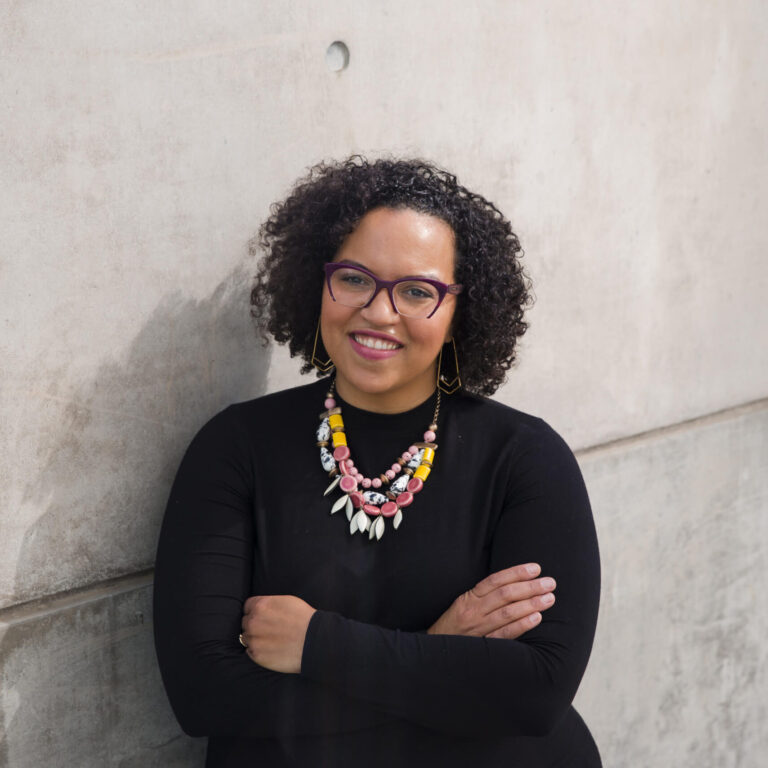
Romi Hall has worked at the intersection of health, housing, and community development for 15 years. She currently works as an expert at this intersection for NeighborWorks America. She is participating in this Q&A on her individual capacity and not as a spokesperson or representative of NeighborWorks America. Romi formerly served as Director of Neighborhood Collaborations at East Bay Asian Local Development Corporation. She co-wrote the SSIR article Connecting Housing, Community, and Health and wrote “Advancing Social Determinants of Health as the Pathway to Recovery for Black People” featured in Centering Black People in Community Development: New Visions from Black Women Leaders through the Center for Community Investment. Romi received a Master of Public Health from Drexel University and an undergraduate degree from the University of Nevada, Reno.
The interviewee is responding to the findings shared in the anti-racist community development Research Project, produced with support from Robert Wood Johnson Foundation (RWJF) to increase understanding of structural racism in community development and pathways to racially equitable outcomes that promote health equity. The views expressed in this article do not necessarily reflect the views of RWJF or ThirdSpace Action Lab.
© 2023 Robert Wood Johnson Foundation