
In many community development conversations, art is treated as the finishing touch. When the housing strategy is set, the budgets are approved, and the plans are finalized, someone suggests adding a mural to activate the space.
When we do that, we misunderstand the purpose of art as a community development tool. Art is not simply decoration added after the real work is done. Art is one of the ways communities develop in the first place.
In communities shaped by structural racism, culture has long functioned as a form of infrastructure. Long before policies arrived – or failed to arrive – people relied on music, storytelling, visual art, and shared rituals to process trauma, preserve memory, and strengthen relationships. Cultural practices created space for reflection and truth-telling when other systems would not.
If community development is about helping communities thrive, then we should take these cultural practices more seriously as part of the work itself.
Over the past two years, I’ve been exploring that idea through a participatory project called Wildcard. What began as a personal challenge – writing one song each month about difficult themes – evolved into a public experience that blends music, visual art, conversation, and play.
Each theme is represented by a hand-painted puzzle piece tied to topics like education, democracy, environmental responsibility, Black history, patriotism, and love. Instead of participants simply consuming the artwork, they engage with reflection prompts designed to spark honest conversation with strangers.
As people complete those prompts, they unlock the ability to place the puzzle piece onto a larger board. Piece by piece, the community assembles the artwork together. Only when the puzzle is complete does a hidden image appear, revealing a message that could not be seen from any single piece alone. No single person holds the full picture of a community. Meaning emerges when many perspectives come together.
Participation itself is rewarded. When I use Wildcard for engagement at an event, guests earn Vibe Tokens by engaging with prompts, answering questions, or playing dialogue-based games. Tokens become currency to exchange for artwork, merchandise, and products from local artists and small businesses. Vendors are compensated in cash through the event budget, ensuring the exchange circulates real economic support for local creatives and entrepreneurs. The dialogue generates value.
After the event, Wildcard documents participants’ reflections, stories, disagreements, hopes, and concerns. The result becomes a living cultural archive, a record of how people in a community are thinking about the issues shaping their lives.
Experience the Idea in Practice
This interactive artwork invites readers to contribute their own reflections and help reveal a collective artwork shaped by community voices.
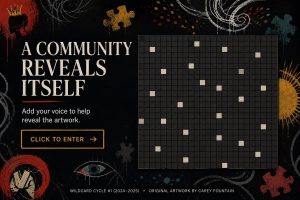
Click Here to Add Your Voice to the Artwork
Traditional engagement tools like surveys or public comment meetings can produce limited participation and surface-level responses. By changing the conditions of the conversation using music, imagery, and storytelling, people tend to reflect and speak with more honesty and vulnerability.
Over time those contributions create a richer understanding of a community’s emotional and social landscape. Imagine a city trying to understand public attitudes about education or environmental justice. A survey might provide statistics. A cultural archive can reveal deeper insights of what people fear losing, what they hope for, and where trust is breaking down. These insights can help planners, organizers, and policymakers better understand not just what communities think, but why.
Wildcard also evolves through those conversations. When certain themes spark deeper reflection or tension, those responses influence the themes explored next. The community does not simply participate in the art; it helps shape its direction.
For practitioners working in anti-racist community development, that shift matters. Structural racism thrives when communities are fragmented and unheard. Cultural spaces that encourage dialogue can help rebuild the relationships equitable development requires.
Art alone cannot solve structural inequities and racial disparities, but it can provide communities with places where people can wrestle with difficult questions, humanize one another, and imagine their future together.
Artists have always helped create those spaces. If we want more equitable and thriving communities, we should stop treating art as an amenity and start recognizing it as infrastructure.
Sometimes the most important work in community development begins not with construction, but with conversation.
Carey Fountain is a multidisciplinary artist, musician, and cultural strategist based in Alabama. He is the founder of Vibes & Virtues, a creative ecosystem exploring dialogue through games, music, art, and participatory experiences. Carey is also the creator of Wildcard, an interactive art project centered on collective reflection and community engagement, and currently serves as Director of Programs & Partnerships at Foot Soldiers Park in Selma.