
We got to catch up with Samira Malone about the state of urban forestry in the United States, why it’s critical to equitable community development, and how we can do a better job of making that connection.
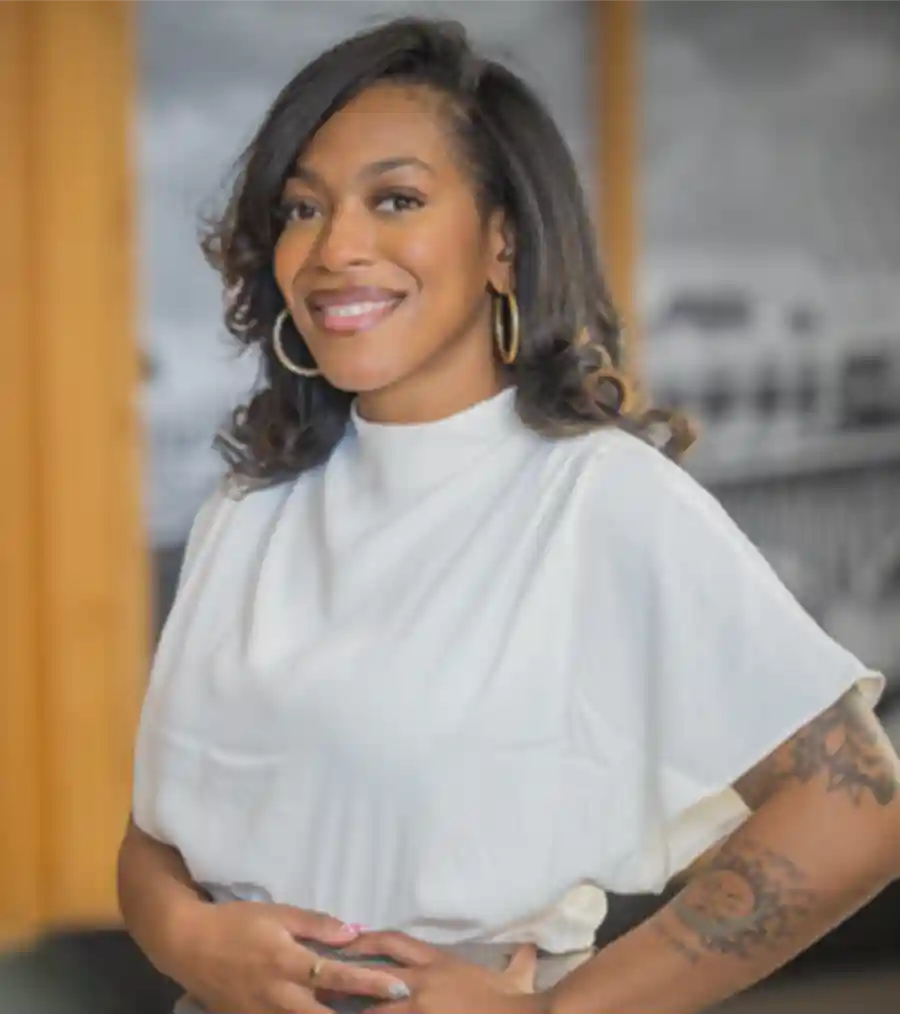
To start, could you share a little bit about your work?
I serve as the National Director of Urban Forestry Initiatives for the Urban Sustainability Directors Network. We support 25 cities across the country in their various urban forestry activities, including planning, maintenance, hiring, workforce development, and education opportunities. I also serve as chair of the City of Cleveland’s Urban Forestry Commission.
What does environmental justice mean to you?
Going to the root and rectifying the fact that many communities of color have intentionally been developed on land that was considered environmentally hazardous or directly proximate to environmental hazards. Justice looks like action. It’s not just an acknowledgement, but there needs to be restoration and healing. Environmental justice is also thinking about stewardship and investment that we are making right now for the future.
Can you speak more to the roles of urban forestry, parks, and greenspace as a community development strategy?
Many cities have experienced a significant decline in urban canopy over the last several decades. Neighborhoods with the smallest tree canopy often have the highest issues with cardiovascular and respiratory health and typically fall within redlined communities. There has been a historical, systematic disinvestment in caring for natural assets in Black and brown and low-income communities. There cannot be community development where people live in thriving environments without a thoughtful account for how we steward our natural environment.
I’m curious to hear about some of the approaches that you’ve seen across the country that you thought were really promising.
Successful tree canopy growth projects prioritize establishment, maintenance, care, and workforce development. Workforce development, in particular, presents a unique and critical opportunity to make significant investments in nature-based jobs – an area where Black and brown communities have historically been excluded. The environmental stewardship field remains predominantly white, despite the fact that tree canopy exists in Black and brown neighborhoods as well. It is essential that the care and stewardship of these spaces be led by people from these communities.
This approach is about more than just workforce equity – it’s a call to reconnect with ancestral knowledge. For centuries, Indigenous people have been stewards of this land, and the forced labor of Black people, especially through chattel slavery, was foundational to the agricultural and land-based economy of this country. Reclaiming that legacy of stewardship is a form of restoration and reparation. What would it look like to reintroduce ancestral environmental practices of care and stewardship as a core element of our future strategies? This question invites us to think beyond growth and towards holistic, community-driven care for our shared urban forest.
Are you seeing any organizations that are doing strong, equitable work on those fronts?
There are many Community Development Corporations (CDCs) and community-based organizations across the city leading grassroots efforts in tree planting, maintenance, and environmental education. During my time at the Cleveland Tree Coalition (CTC), we were able to support several of these initiatives with grant funding, helping to strengthen local capacity and deepen community engagement. These organizations play a critical role in fostering a sense of stewardship, ownership, and care for the city’s tree canopy, ensuring that environmental benefits are accessible to all neighborhoods, especially those that have been historically underserved.
A powerful example of this work is the Rid-All Green Partnership, which transformed a neglected and heavily dumped-on site in Cleveland once known as the “Forgotten Triangle” into a thriving community resource. Today, Rid-All operates a tree nursery within the city — a significant achievement considering that most tree nurseries in the region are located outside of Cleveland. This shift addresses a critical supply chain challenge that has long hindered efforts to scale up the city’s urban forest. By growing trees locally, Rid-All creates a more accessible and sustainable inventory for planting projects while reducing reliance on external suppliers.
What makes Rid-All’s approach especially noteworthy is its emphasis on circular economy principles. They produce their own densely nutrient-rich soil on-site, using recyclable and compostable materials processed through their farm operations. This “waste-to-resource” model not only supports tree cultivation but also enables the growth of fresh fruits and produce, which are sold back to the community at affordable rates. This approach provides a triple benefit — improving environmental health, supporting local food systems, and creating economic opportunities for residents.
We’re seeing more communities adopt this less exploitative, hyperlocal model, where local materials, labor, and knowledge are leveraged for community benefit. Historically, major corporations have monopolized access to inventory, materials, and contracts in urban forestry and green infrastructure projects. By supporting community-led efforts like Rid-All and other grassroots initiatives, we’re challenging that dynamic and reclaiming local stewardship. These approaches are essential to building a more just, sustainable, and self-sufficient urban forestry system.
What are some other hopes you have for the future and moving towards a more environmentally just world?
I hope that the environmental landscape continues to open up and leave real reverence for community perspectives – not just to be heard, but to be centered and given autonomy and agency to carry out the work. There also has to be a continued pipeline to continue to invest in this work. We are going to continue to deal with exacerbated climate hazards and Black, brown, and other vulnerable communities are going to be on the frontline. If we’re not thinking about how community development could be leveraged as a strategy for fortifying our communities for what we know is on the horizon, we are willingly putting them in harm’s way.
What do you think sustaining the work looks like beyond a federal windfall of funds?
I hope that all of the federal provisions that are being made possible through these federal block grants are being leveraged smartly and we see more investment in sustainability work. We’ve been having conversations with communities to get a gauge of their needs and their existing kinds of funding assets or access to funding. There is a great deal of courtship and investment that needs to be happening from our philanthropic and corporate partners. We also need to sit down with our economists and strategists to figure out some mosaic tile funding approaches to how we’re going to be able to sustain this investment after five years. What does it look like to be able to leverage federal funds to tap into additional resources? Especially in cities dealing with budget deficits, the first things on the chopping block are things that are not viewed as municipal necessities. Environmental assets have to be a municipal priority, because they are municipal pieces of infrastructure, one of the few pieces of infrastructure that don’t decline in value over time.
Is there anything else that you want to make sure people don’t lose sight of?
If we’re thinking about this through a lens of community and economic development, we need to start thinking about the infrastructure that we’re going to need to accommodate climate refugees. That’s been a conversation on the periphery in the climate space, but we’re heading toward a time where people are going to have to make mass exoduses out of parts of this country because they are going to be far too unlivable. For underinvested regions that people might be more likely to move to, we have natural assets that we can be leveraging and investing in to make them livable places not only for the people who are already here but for new arrivals. If done thoughtfully, investments in our environmental conditions can really fortify an even stronger community.
Samira Malone is the National Urban Forestry Portfolio Lead at the Urban Sustainability Directors Network, where she works to enhance equitable access to urban tree canopy and advance climate resilience efforts across the country. She previously served as Executive Director of the Cleveland Tree Coalition. Samira holds a Bachelor’s in Urban and Regional Planning, a Master’s in Urban Planning and Development, and GIS certification.