Issue #08:
Safety for All Isn't a Privilege – It's a Prerequisite.
Community Development and Safety
May 2025
Illustrator: Derick Jones
Terms and Conditions
Designed and developed by XC Design

Five years ago, in the midst of a global pandemic, the world watched as the police brutally murdered another Black man, who called out for his mother. Another life, at the hands of public safety. The cost of serving and protecting – whom? In community development, we aim to create the conditions for all people to thrive in our neighborhoods. Safety arises as a top priority and focus area in many neighborhood visions, in public meetings, on our Main Streets, and in our public spaces. But what actually makes people feel safe? And how does narrative play a role? Research shows an increased belief that crime is increasing, despite declining rates of crime across the country. If you’ve been following along with us, you won’t be surprised to see whose safety is typically prioritized – and at the cost of which communities. So what does it mean to foster safety for all?
When the concept of safety is weaponized, it turns against the very individuals who bear the greatest risk and vulnerabilities from unsafe conditions. Under the guise of safety, police forces, which disproportionately harm Black and brown individuals, become increasingly militarized. Black communities are over-policed yet face under-responsiveness. Calls for safety involve clearing the shelters of those who experience homelessness, ignoring the increased risk of violence unhoused persons face. Immigrants are othered as violent criminals, rather than uplifting full humanities.
When we problematize residents, not systems, we ignore the decades of disinvestment that have created the conditions that fail to meet the basic needs of communities. When we ignore root causes, we get surface level, band-aid solutions. We ignore the prison boom in rural, predominantly Black and brown communities, where prisons have become a core economic development strategy. We criminalize Black mobility in our streetscapes, even through traffic safety mechanisms.
And yet. We can reclaim safety. Communities are fighting for policies and practices such as the reduction of police presence in instances of traffic violations or fare aversion on public transit. Communities are supporting a care response through meeting basic human needs of shelter, food, affordable healthcare, and arts and culture. Communities are creating safety through rapid response networks, through organizing solidarity and base building in sanctuary cities.
In this issue, we highlight just some of the people and organizations who, when they talk about safety, think about a softer side to safety. The right to safety, particularly for those among us who are the most marginalized or who experience the least safe conditions. The freedom to imagine a better future. To exist as we are, with our families, in our bodies. As Delvin Davis prompts us in this Issue, to get different answers regarding community safety, we might need to ask different questions. So join us in interrogating the concept of safety, and how community development can achieve communities that are truly safer for all of us.
Racquel Banaszak (Bad River Band of Ojibwe) is a visual artist and educator based in Minneapolis, Minnesota. Her people are from the northern waters and woodlands. She has grown up around Native and urban communities. She is continually inspired by her mother’s stories, urban relocation, and Indigenous pop culture. Her works often combine photographs, illustrations, beadwork and textiles as a way to build futures full of joy and hope. She is a doctoral student in the department of history at the University of Minnesota.
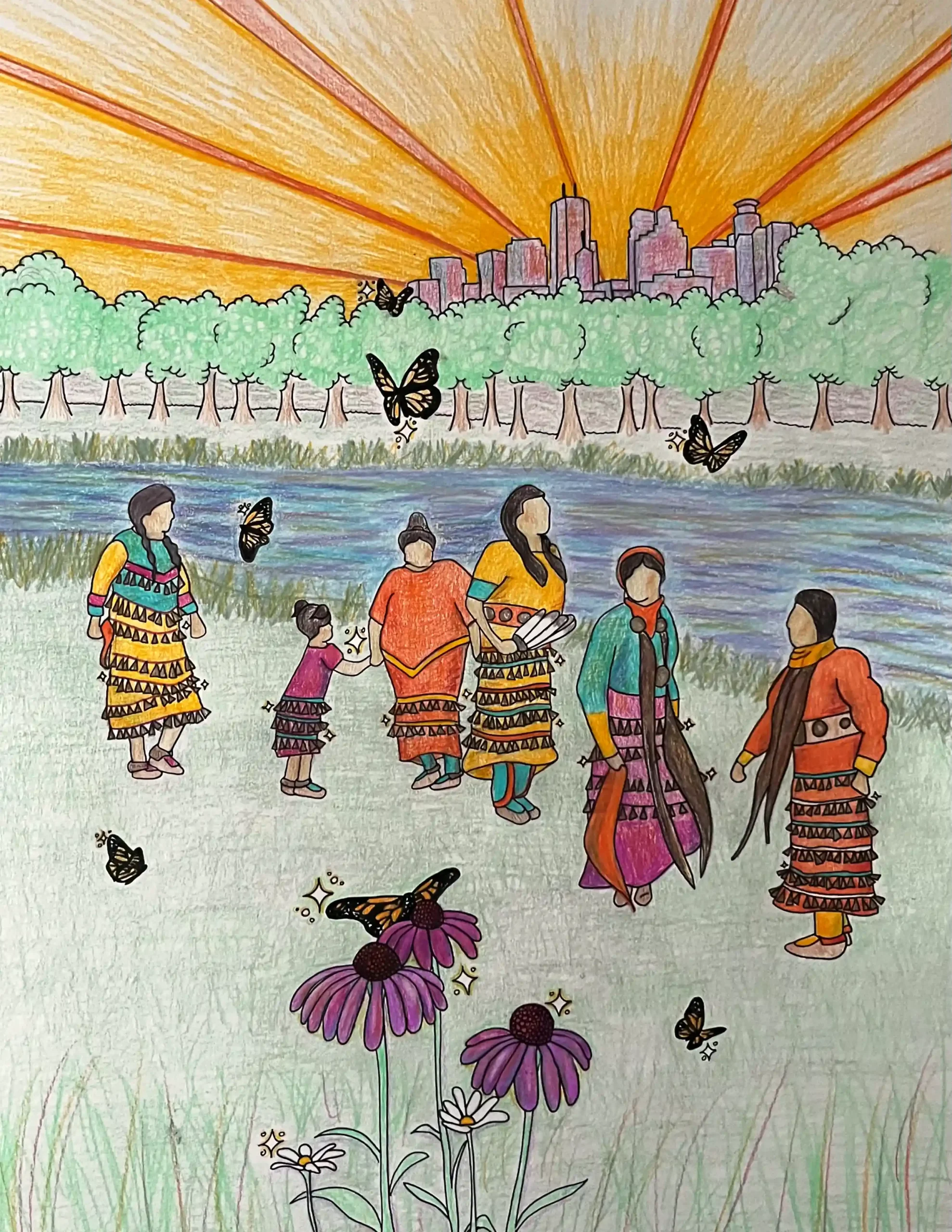
Time for Healing (left)
Following the protests against the murder of George Floyd in Minneapolis in 2020, jingle dress dancers shared the jingle dress dance with community members as a way to help heal from the immense hurt people were feeling. This is an important healing dance to Ojibwe and other Indigenous communities. Some say its origins were during the 1918 influenza pandemic when a young girl had a dream of dance that had healing powers. The butterflies that surround the dancers remind us of the growth that comes with change.
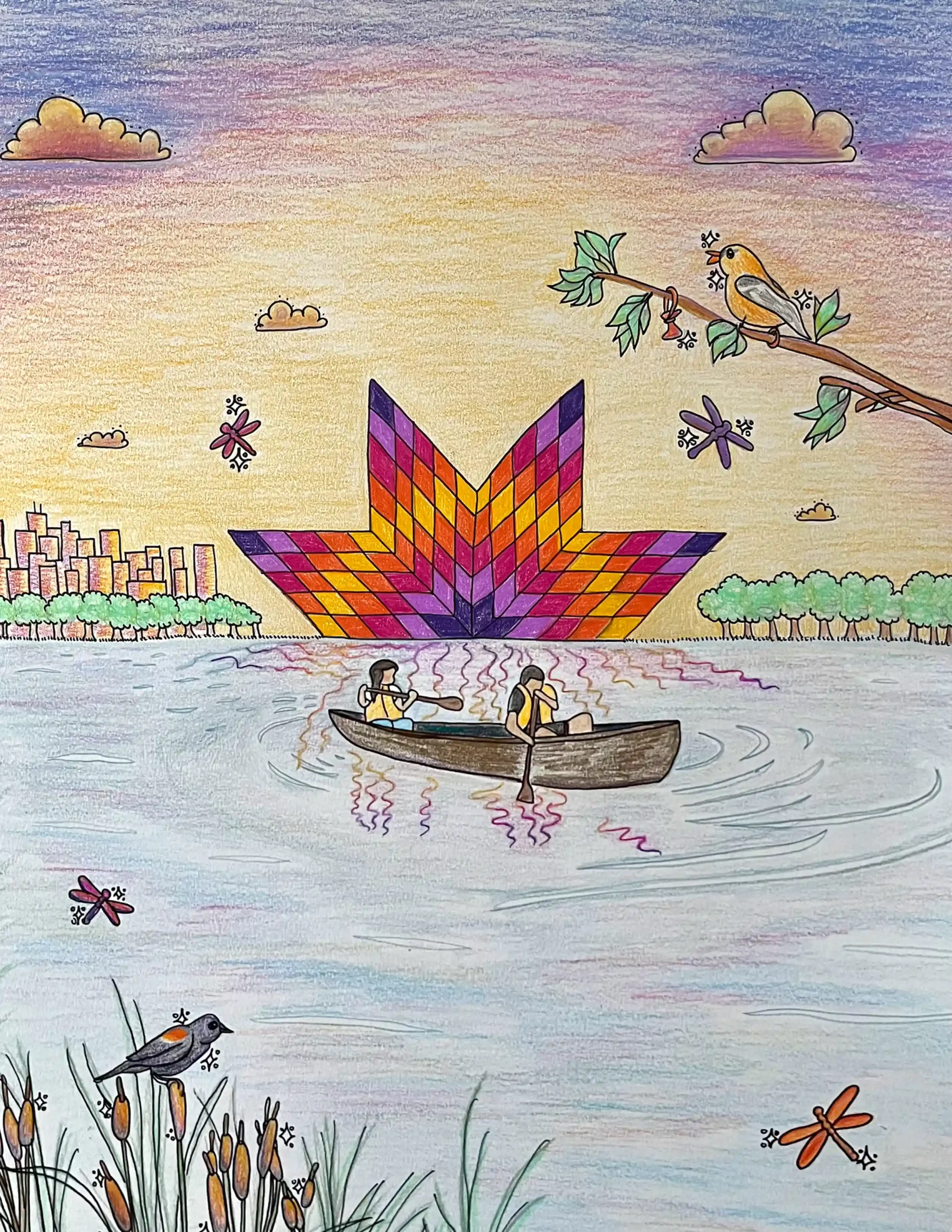
Time for Joy (right)
All the water that sustains us today is the same water that sustained all of our ancestors generations ago. It holds memories of past and present and will carry us into the future. “Time for Joy” was inspired by a summer camp for urban Native youth where we canoed along the waterways in Minneapolis. Even living among the concrete jungles, water connects us to all our relatives from the birds and dragonflies to the cattails and cosmos. With every sunrise, we are grateful for this gift of life.
May 25, 2025 marks the five-year anniversary of the murder of George Floyd by a Minneapolis police officer. And in that time, as the Program Director of the Communities Transforming Policing Fund (CTPF) at Borealis Philanthropy, I’ve had the great honor of supporting dedicated and strategic movement organizers across the country who are working tirelessly to move us from daily tragedy to new lived reality.
The life and painful death of George Floyd sparked national protests for racial justice, accountability, and new visions of community safety. They also brought the legacy of police violence against Black Americans into sharper view. According to Mapping Police Violence, in 2025, Black people remain 2.8 times more likely to be killed by police than white Americans. Many majority Black cities also spend a high proportion of their overall budget on police. In 2020, Milwaukee spent a staggering 58% of its budget on policing, and other cities like Memphis (38%), Wilmington (34%), Newark (29%), and Baltimore (26%), spent over a quarter of their budgets on policing. The demand to shift power and resources to community-based safety strategies as opposed to policing, surveillance, and incarceration was a strong anti-racist community development demand led by Black, Indigenous, Latine, and people of color organizers across the country.
These activists and organizers have faced unrelenting backlash and a political climate unlike any we’ve seen in generations. But in the words of the poet Dinos Christianopoulos – words adapted by the revolutionary Zapatistas: “they tried to bury us, but they didn’t know we were seeds.” In the face of antagonism, deepening networks of community care and safety have taken root and bloomed in new communities across the country: bail funds, mutual aid funds, community defense, and community-led safety programs.
For example, CTPF supported the growth of The Black Response Cambridge which developed and helped incubate Cambridge HEART, a grassroots organization led by individuals with lived experience serving as a holistic emergency alternative response to police. The Black Response worked with organizations across Massachusetts to map the landscape of community-based alternatives to policing.
CTPF also resourced Embody Transformation, an organization led by women of color who were a part of successfully advocating for resources to be shifted from the Austin Police Department budget back to community. One of their recommendations was to shift resources to a guaranteed income pilot. This pilot has had a profound impact on the individuals and families who received the support, including substantial improvement in housing stability and food security. As a result, Embody Transformation is building on the pilot to create a Roots of Care Project, which will combine guaranteed income support with community power building and leadership development to support caregivers in advocating for the community they want to see.
CTPF has also supported community-safety work grounded in a healing justice framework. Individuals who have been directly impacted by policing, surveillance, and criminalization lead many of the organizations that we support. As a result, their organizing comes from a place of passion and also deep pain. In addition to working together to advocate for significant changes in policing, these changemakers have developed networks of healing support programs for other families who have lost loved ones to police violence. Michael Brown Sr. Chosen For Change, The Miles Hall Foundation, Cary on the Ball, and Faith for Justice are just a few examples of our partners who are leading their work with healing at the center.
Through resourcing this work and engaging in deep partnership with movement leaders, we recognized that the demand to shift power and resources to communities was not only a demand of police, but also a demand of philanthropy. In the fall of 2021, CTPF shifted to become a participatory grantmaking fund. Today, all of our multi-year grantee partners are selected by a participatory grantmaking committee composed of individuals who have been directly impacted by criminalization, policing, and incarceration, and who have led, worked within, or served alongside organizations working to decriminalize communities, end police violence, and improve community safety. For the past four years, their leadership has reshaped our grantmaking portfolio in beautiful and profound ways.
Half a decade after the loss of George Floyd to police violence and the racial justice uprisings that followed, we have an opportunity – and obligation – to reflect on the space between the harmful narratives that exist about communities and the anti-racist demands of the movement that has seeded transformative approaches to community safety. CTPF is deeply honored to support the brilliant and liberatory organizations co-creating a world in which the needs of communities are prioritized, and their visions of health, healing, and safety are resourced in abundance.
Jeree Thomas is a Black, disabled southern woman dedicated to the liberatory imagination and safety of Black, Indigenous, people of color. She is the Program Director of Borealis Philanthropy’s Communities Transforming Policing Fund (CTPF). Before joining Borealis, Jeree was an attorney for incarcerated youth and served as a national policy director with the Campaign for Youth Justice.
We caught up with Liz Ogbu to discuss safety in design and the need for addressing grief, building trust, and storytelling.
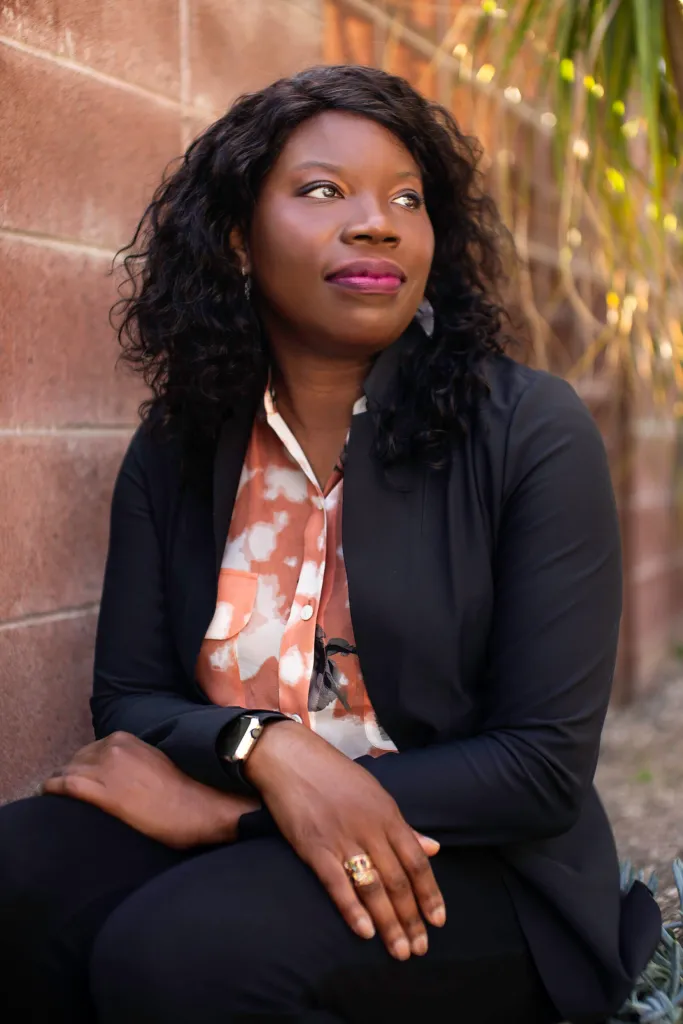
Tell us about yourself and your spatial justice work.
By holding my role as a grief worker or spatial justice activist, I’m making an intention to steward more than what an architect typically does. Spatial justice is the idea that justice has a geography. It requires equitable access to opportunity and resources. We know that those living in unjust geographies are often Black, brown, or poor. It is not possible to achieve justice if space selectively harms people.
The tools of our profession have been used to create harm. While many communities protested highways, the successful protests tended to be in white neighborhoods. Who ended up getting harmed? In Tulsa, the community came together and rebuilt Black Wall Street after the 1921 massacre, in the face of changed building codes subverting their efforts, insurance payments that were not paid out, and banks that refused to give loans. But what destroyed it for good were the two freeways that were sited in that neighborhood 40 years later.
My work is committed to making space part of the conversation about achieving a just future. How do we support communities, as they are building toward a brighter future, and ensure that the spaces they live in contribute to – rather than impede – that future?
Can you share more about your approach and tools you use to remedy this harm?
One example is Kindlewood, a 50-year-old Section 8 development sitting on the site of a former plantation in Charlottesville, Virginia. Piedmont Housing Alliance and National Housing Trust, its nonprofit owners, are working to redevelop it, transforming it into a mixed-income community. Importantly, they’ve committed to doing so with zero displacement and with existing residents serving as co-decisionmakers in shaping its future.
We have to broaden the definition of “client” to include whoever our actions impact. The traditional design process privileges the client who writes the check, so I try to make sure the broader client has equal, or greater, weight in decisionmaking.
We created an advisory group, compensated them, and met monthly. We trained and supported them to make major decisions about the development, from the architects hired to the distribution of income levels. Redeveloping existing low income housing into a mixed-income development can be controversial and feel like an on-ramp to displacement. So early on, I interviewed residents to ask what they wanted to see. Their answers were very rational. For example, they felt living next to market-rate units would provide opportunity, connections for jobs. They wanted to be secure in their homes, but they also wanted access to something better. Our efforts had to be accountable to supporting both outcomes.
I have to create room for residents to be able to dream. Where there has been harm, there can be scarcity. Expansive dreaming feels like a luxury. So we need to ask, what do you need to be able to thrive? That, too, can be part of what we create.
With Kindlewood, we’re not just creating housing. We’re looking at building generational wealth. Educational opportunities. Community belonging.
You said you’re one of the longest tenured in Kindlewood.
It’s been almost ten years, and six more to go. We can’t lock engagement into a tiny phase that happens when we’re figuring out what we want to draw. We’re stepping into places where there has been a long legacy of unfulfilled promises. We need the full participation of the folks who have been harmed and who we want to see as the ultimate beneficiaries. I may have decades of experience, but I will never be the expert of that place. It is my responsibility to connect with the people who are and to learn from them so I can support them to be fully in the process.
I am willing to listen, to hear their hurt. I acknowledge their pain. I hold space for them as human beings. In group situations, I hold space for grief, not moving to the speed of an arbitrary timeline. We were working on a community vision for a decommissioned stretch of a highway in Akron when Jayland Walker was killed horrifically in a police shooting. We had milestones to meet, but people were grieving. I had already heard repeatedly that the highway, the Innerbelt, was just one piece in a long history of not being valued. So I held a grief ritual. That bonded us more as a group, and the community could be in a deeper relationship with one another.
One of the narratives we talk about is the Blank Slate Narrative, the idea of cultural erasure and building without acknowledging past histories or harm. How do you address this false narrative, and what new narratives are you pulling forward?
I think most people have good intentions. But starting as if this is point zero feels harmful to community members who remember the past. If you erase part of my story, how can I trust you to hold any of my story? In Akron, most people hadn’t talked about what had happened for 50 years. For some residents, that land was a highway, a way to get to work, and for some residents, it was a home that had been taken from them and destroyed. We couldn’t have a community-wide vision without a common understanding of the context that we were planning from.
Story-collecting and storytelling were key to this. Stories enable us to create better, holistic community visions centered on healing and thriving, and not just the built object. I want to make sure the ones who experience a loss are the authors of their stories.
The new narratives are rooted in storytelling of the people who have experienced them.
Right. And how are we creating processes so that people can dream of what might be a safe community, where they feel belonging? Part of taking time to build relationships is making sure we are creating a safe place in which to both articulate your hurts and desires, and to establish a framework for collective dreaming. Safety is not only about feeling like we’ve created a place where you can be supported to live your best life; it is also about the process to get to that vision. There needs to be collective care and accountability, so that even when things don’t work, people can move towards repair.
What are some other promising practices that are making you excited about the field?
So many issues are comingled. Spatial injustice is also about economic injustice, environmental and climate injustice, and so on. Also, how are we weaving trauma-informed and grief-engaged practices into our processes? I’m inspired by groups like The Embodiment Institute that look at trauma within communities of color, and share tools to learn about and tend to the embodied experience of it. Sue Mobley and her team at Monument Lab’s Re:Generation project support community
A designer, spatial justice activist, and grief worker, Liz Ogbu is an expert on engaging and transforming unjust urban environments. Her multidisciplinary design practice, Studio O, operates at the intersection of racial and spatial justice. Among her honors, she’s a TEDWomen speaker, Aspen Ideas Festival Scholar, and Rockefeller Foundation Bellagio Center Fellow.
Fariha Tayyab is a multidisciplinary artist whose work lies at the intersection of art, journalism, and community building. Her storytelling revolves around the themes of identity, belonging, and social justice. She is passionate about uncovering untold stories of various populations through creative writing and photojournalism.
As a polyglot and lover of culture and travel, Fariha believes in the power of language and visual narrative to transform society by shifting perspective and generating waves of tolerance. She is passionate about working with young people, building literacy in institutions, and serving housing insecure populations. When Fariha is not creating art or serving her community, she is planning her next adventure, looking for the next fair trade coffee shop, or meditating after some poetry.

This question was posed to me in 2017 by a community organizer in Durham, North Carolina. She asked everyone in the room to close their eyes and search our memories for a vision of what a safer city could look like. The question was a challenging one. At the time, our collective thoughts were still colored by the litany of unarmed Black people losing their lives at the hands of law enforcement.
Eric Garner in New York, Michael Brown in Ferguson, Tamir Rice in Cleveland, Walter Scott in North Charleston, Sandra Bland in Texas, Freddie Gray in Baltimore, Terence Crutcher in Tulsa, Philando Castile in St. Paul, and Alton Sterling in Baton Rouge were all stolen from their respective families and communities over the prior three years. Some were stolen under the cover of darkness – others on camera in broad daylight. In each of these cases, Black people were taken by law enforcement under sworn oath to keep us safe.
So any question about safety, at least for a Black man like myself, is not one with a clean or simple answer. The question asks me where I would invest governmental resources. The question asks me who I would call first if my safety were threatened. The question asks me if I felt safe in my Black body in the moment – and if not, why?
To be honest, my deepest recollections of safety stem from childhood. Going to fishing trips and high school football games with my dad. Sunday morning church services watching my mom sing in the choir. Watching cartoons and reruns of Sanford and Son in my room on an old black-and-white television with bunny ear antennas. My greatest pressures in life were maintaining good grades and wondering if Michael Jordan would ever win his first championship. The only things I needed for safety were my family and community. My people kept me safe.
Maybe there’s a dash of naivete baked into my youthful nostalgia, but the safety I felt growing up in rural North Carolina never needed any investment in prisons or police. As long as my community was thriving and intact, my needs were taken care of. Now that I’m an adult, I’ve learned that public investment in an anti-racist community has never been as easy as my childhood memories may have implied, especially when competing against “tough on crime” politics and rhetoric.
Today, a fear-based narrative fuels public policy where Black children are seen as something closer to “super-predators” deserving of discipline than kids deserving of love. Perceived child villainy then justifies school suspension and expulsion, which are strongly correlated to school dropout. Children who drop out of school are over three times more likely to be arrested as adults later in life. Incarcerated adults then have a much harder time securing employment and housing opportunities – important factors needed to avoid recidivating back into the system. Our country’s prison population has swelled to 1.2 million people, with Black incarceration rates at five times more than our white counterparts. This could be a measure of failure or success depending on how you define community safety.
If your definition of safety is built on Black paranoia, or the need to profit financially off of incarcerated people, then the system’s design is probably working perfectly. But for those who define safety as the vision of a thriving, anti-racist, well-resourced community free of societal barriers, things must change with all deliberate speed.
If we learn nothing else from the first sentence of this essay: In order to get different answers regarding community safety, we may need to ask different questions.
Do the billions we’ve invested in prisons and police make us feel any safer? Would a comparable investment in schools, job creation, affordable housing, and mental health care be just as strong of a crime deterrent? Can we change a political culture to reward Black success over Black incarceration?
The answers for a safer world that’s not dependent on incarceration are there if we work for them, invest in them, and have the energy to maintain them. A safe Black community is always worth that work.
Delvin Davis is the Interim Policy Director with the Southern Poverty Law Center where, since 2018, he has conducted research to promote progressive public policy for criminal legal reform. His most recent work includes a five-part series titled “Only Young Once,” which details the dynamics of youth incarceration in the Deep South. Before SPLC, he was a Senior Researcher at the Center for Responsible Lending, where he did similar work in the field of economic justice – promoting regulation for predatory lenders and shrinking the racial wealth gap.
We grabbed some time with Syrita Steib to discuss changing systems and mitigating harm.
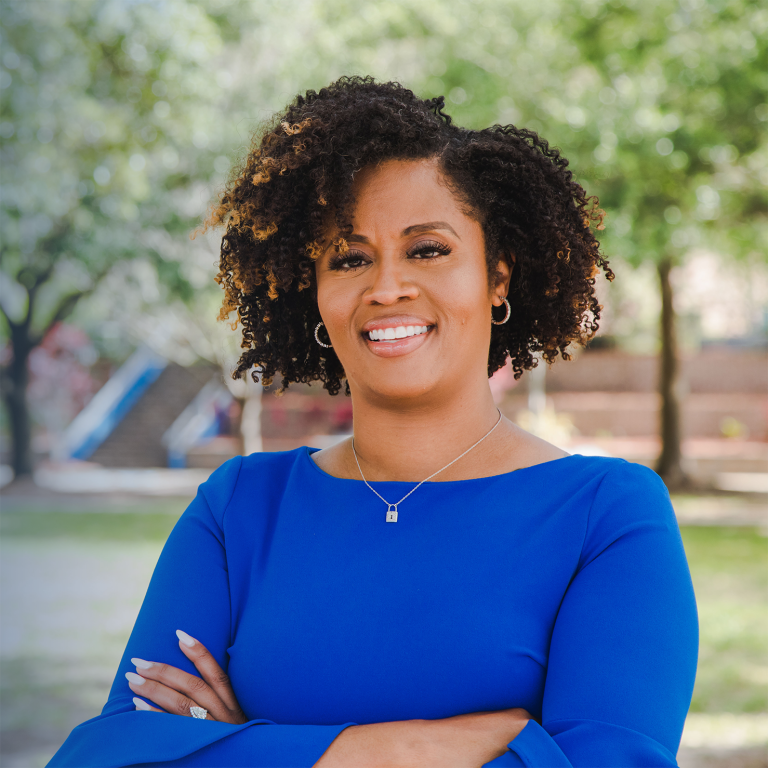
First, can you share more about how you came to community development?
When I think about community development, I think about where I live, but also the communities I belong to because of my gender, race, and experiences. When I think about community in that more expansive way, I find more points of intersection with folks. What are the things we already have access to? How can we capitalize on those things? What are the key things that can get us where we need to be? We start with information. People don’t always know what they have access to, or what actually exists. Let’s start at the beginning, giving people the information they need to understand what they’re experiencing, what’s happening, and how to move forward.
Can you speak more to how you embody the anti-racist community development principles in your work?
We have this assumption that everyone who is doing social justice work understands racism at its core. But what does racism actually mean? We have to start with the definition, and then we’re able to build anti-racist frameworks, ideologies, and programs.
We are intentional about creating solutions through holistic ideologies. I think about barriers to someone who is a woman, or who is Black or brown, for something as simple as opening a bank account. In New Orleans, people may not have access to proper documents, or they may have been destroyed, like in Hurricane Katrina. That happened a lot in the Black community. People lost their whole histories, or no record of graduating from high school. So when we are assessing someone for programs, rather than asking to see their identification, we ask, “Do you have a birth certificate or social security card?” And if the answer is no, we ask if they need support to obtain those documents. We don’t assume that they know where they can get those documents – and the Office of Vital Statistics is in the same building that we’re in. I’m not assuming that everyone has a debit card or Venmo. We start by assuming absolutely nothing about the person who shows up. Through the questions we ask, we can determine how to support that individual. Biases and racism often show up in the way in which you serve people, if you hold an assumption that they have the same access and level of access that you have. So a powerful way in which we do that is to not assume anything about anyone. The biases in how you support people fall away, because you actually allow a person and their humanity to drive the support.
How do you approach thinking about safety?
How do we mitigate harm to people while we’re navigating these systems? The systems themselves are punitive, harmful, and dehumanizing. Damage is inevitable, so how do we mitigate the damage? It’s about knowing your history. Police forces originated from slave catchers, so we have a system rooted in this history, and under the 13th Amendment, the only time slavery is still currently legal is when people are in prison. So you have police essentially still acting as slave catchers. We have not had an opportunity to call the police when something in our community was a mess, because many times the people on the police force were part of a white supremacist group. So in a Black community, we’ve never had an opportunity to rely on police forces.
So we try to work inside our communities to get people to problem solve, before calling the police. Is this a mental health issue? A public health, or public safety issue? We have become dependent on the police force to handle all types of issues, and that’s unfair to the police too. They’re not mental health professionals or family counselors. They’re put into a position to deal with things they shouldn’t be dealing with, and we as a community have lost our way to figure out how to handle most problems inside of our community. For me, it’s both understanding the history of what the public safety system actually is, and how we should be working to achieve true safety. For the system to operate properly, we have to have a reckoning of how it was created and its actual function.
It sounds like thinking about working within systems not created for us, and creating new systems.
It’s not necessarily creating a new system, but introducing people to how they should be, what their existence should truly be. We were not created to operate inside of these white supremacist, patriarchal systems. We were created to contribute to the world. We were created to be our best selves and operate on high frequencies.
Every system, every institution was created by man. It didn’t just exist naturally, it was created. And I don’t believe people were created to exist inside of these conditions. Prisons, hospitals, schools – they were all created in the same mindset by the same people in the same way. If you go into a school and look at the linoleum floors and cement walls, it’s built just like a prison. A hospital is the same way. They all use the same framework, designs, architects, and then we hold these up as the gold standards. But they were not created with inclusivity in mind. No system was created with different ethnicities or races in mind, or considering people who are different genders or gender nonconforming. The systems were created for white men. We’re trying to fit a multicultural, gender-expansive community into a system that was not designed for anybody other than one group of individuals. That’s why they aren’t working. So rather than reforming or fixing the system, we need to design new ways of being, new ways of existing, and new ways of working that better reflect who we have in this country today.
What are some things that are making you excited?
Being in Louisiana can be tough, but our most recent election makes me really excited. We had been in the streets, talking to people, and we voted down all four constitutional amendments that would have been extremely harmful. This amendment would have allowed kids to be sentenced as adults for any crime. In the state of Louisiana, you can charge kids as young as 14 years old for violent crimes. This amendment would have enabled kids to be charged as adults for all felonies, including theft, fighting, assault, all up to the discretion of the district attorney. So we were able to vote that down. So many groups on the ground launched this massive campaign. Statewide, we turned out, especially the Black communities.
So what are some hopes that you have for the future?
What gives me hope is the kids – they are involved and want to know what’s going on. They’re fighting their own fights. Whatever generation it is, we have to celebrate the people who are coming behind you, investing in them. I’m excited about these kids. They are standing up and are on the front lines fighting.
A native of Vacherie, Louisiana, Syrita Steib founded Operation Restoration, a nonprofit that works to support women and girls impacted by incarceration to recognize their full potential, restore their lives and discover new possibilities. Syrita is recognized nationally for her work on dismantling the criminal legal system.
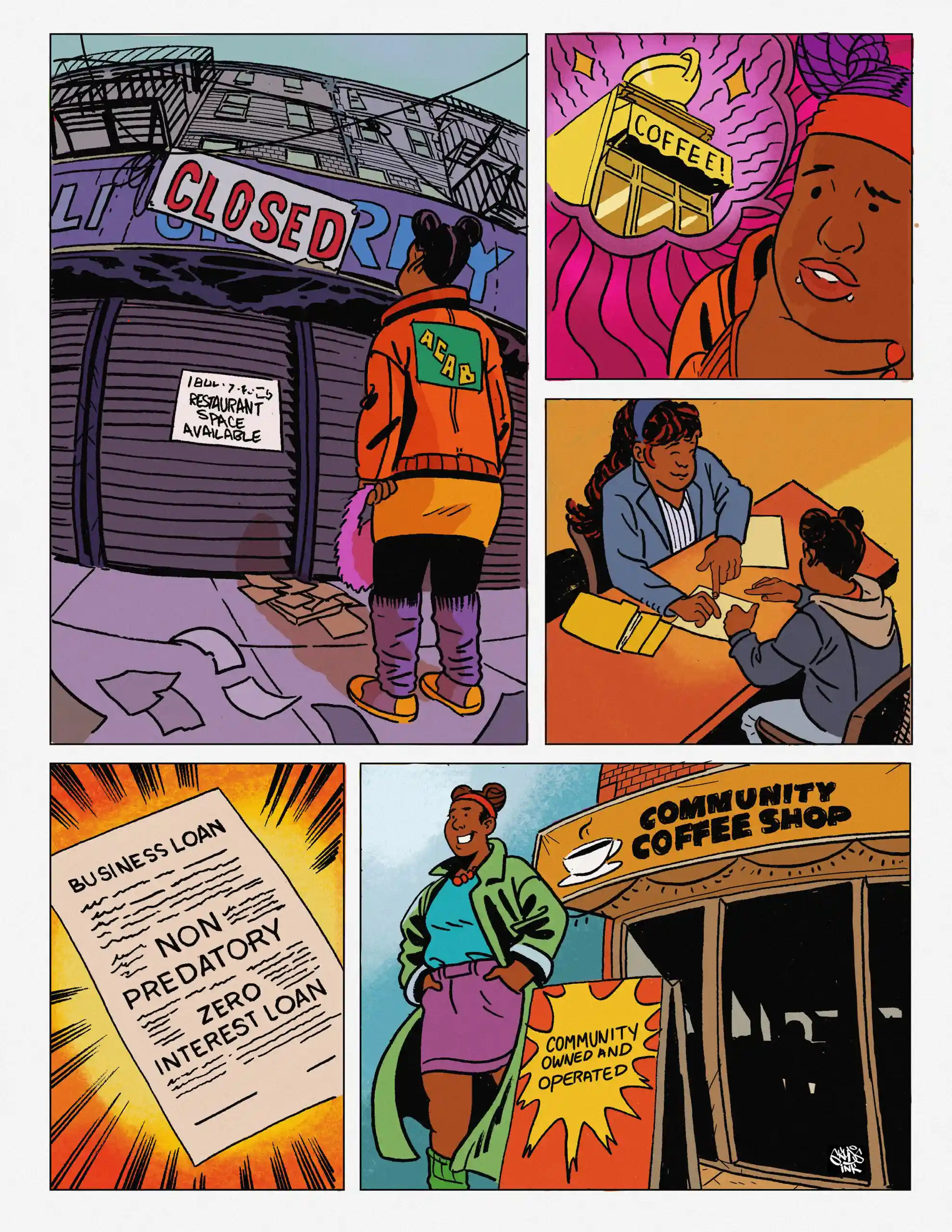
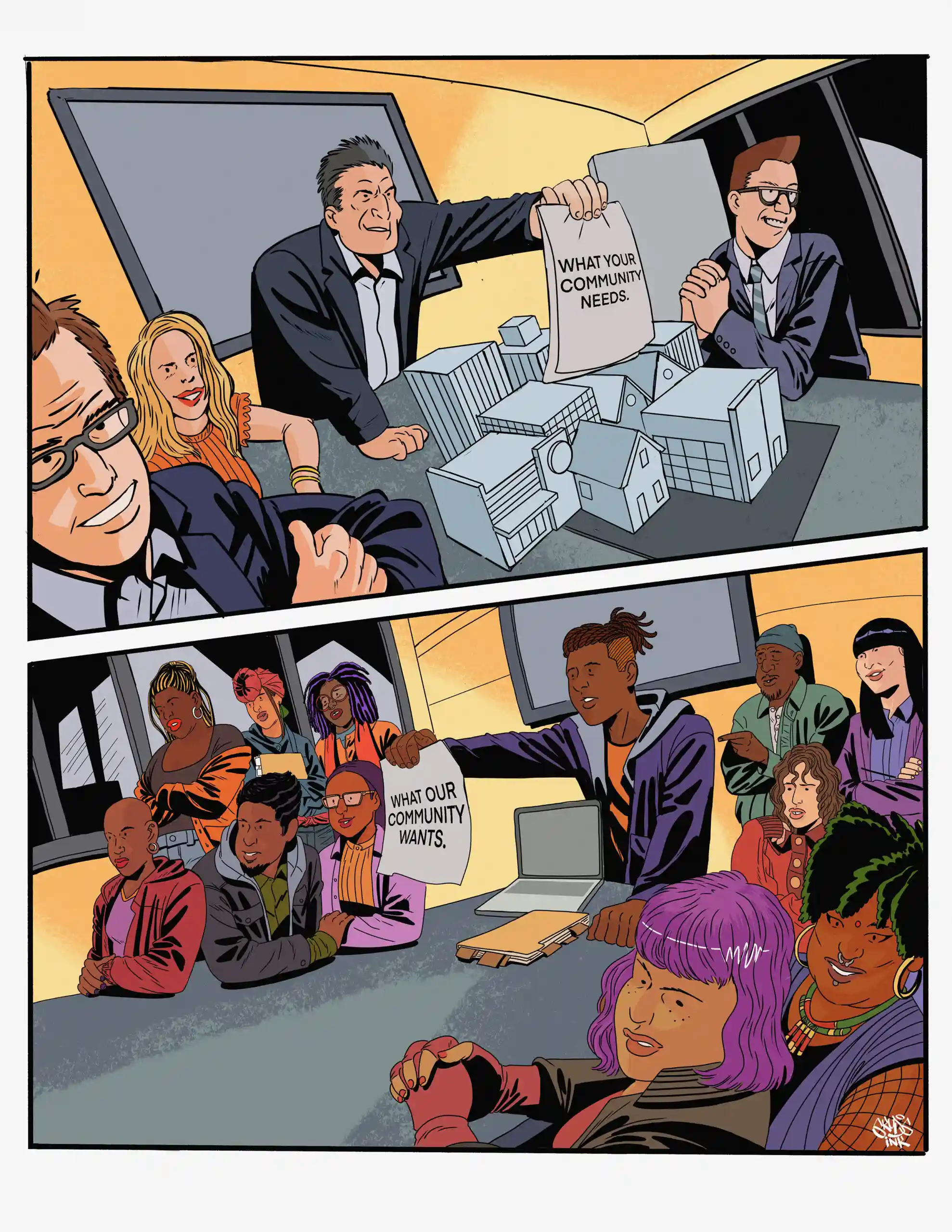
Derick Jones is a NYC-based cartoonist. He specializes in bringing a dynamic edge to everyday life. Whether he’s doing poster designs for the Super Bowl-winning Philadelphia Eagles, or drawing heads exploding in his acclaimed comic book series Nose Bleed, Derick strives to wow and excite his audience. Follow him on Instagram @skudsink.
Coffee Shop (left)
In this piece, I brought myself back to living on Kensington Avenue in Philadelphia. That place is a mad house but the people there are lovely individuals, and all the shops are owned by people that live in the neighborhood. I always wondered how they got their start. If it were easier to take out loans and pay them back, how many more shops would pop up and add value to the community?
What your community needs vs. What our community wants (right)
This piece was inspired by my time living in Point Breeze, Philadelphia. At the time gentrification was hitting this neighborhood hard. All the food spots and cool businesses and houses were being torn to shreds and replaced with crappy architecture and even crappier food options. Coffee that tastes like battery acid replaced the Vietnamese and Thai tea places I frequented. How could the neighborhood feel if the developers first asked what the community wanted
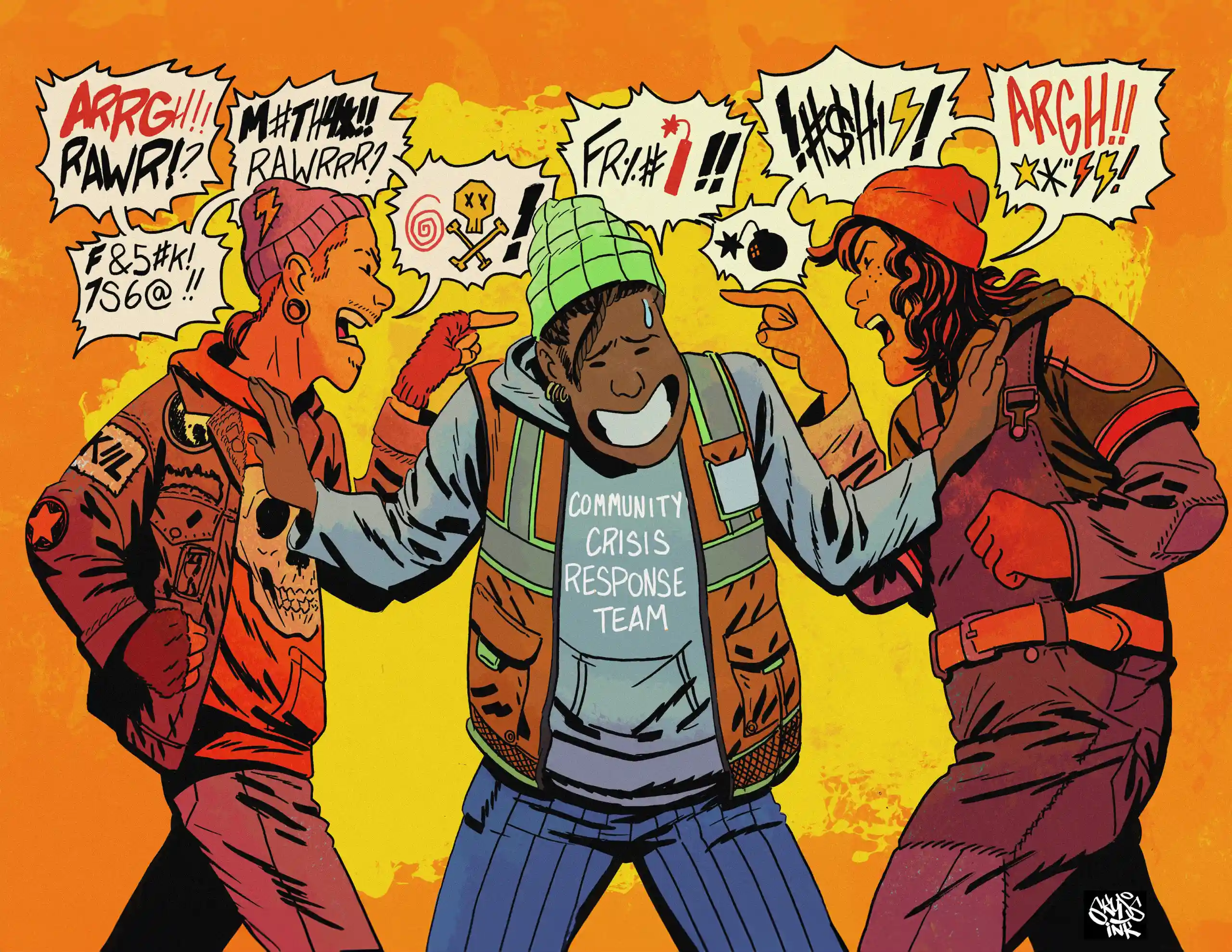
Everything wrong in our world (cover)
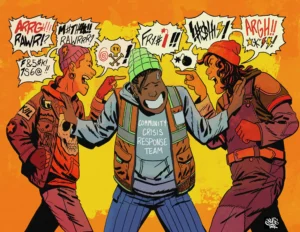
I always wished cops and law enforcement were actually the good guys – superheroes that patrolled the streets and brought a smile to your day because you felt safe knowing you were being watched and cared for. That isn’t the case, and while it’s easy to blame the people behind the badge, I think it goes deeper than that. I love the idea of community crisis response teams as an intervention.
Toni Morrison and Ming Smith remind us that Black spaces are not merely places we occupy; they are sacred, self-sustaining sites of belonging, grounded in solidarity and the pursuit of safety central to liberation. I first encountered their works in high school, a time when I was navigating girlhood in a predominantly white school. Accessible but not inclusive, this environment was not designed with my protection in mind. Through their stories and images, I discovered alternative sanctuaries – places where Blackness, in all its complexity and beauty, was held.
In my creative practice, which strives to cultivate spaces that affirm and center justice, the works of Morrison and Smith have been instrumental in challenging the false narrative that people must endure inhospitable environments to gain power and access – an idea commonly mistaken for safety.
In The Bluest Eye, Toni Morrison introduces Pecola Breedlove, a young Black girl who believes that possessing blonde hair and blue eyes will shield her from the cruelty around her. In her search for acceptance, she loses her sense of self and spirals into madness. To remind her of her beauty, her friends plant marigolds, but the flowers fail to bloom, unable to grow in the infertile soil. Pecola’s story serves as both a commentary on Black girlhood and a critique of the structural inequities that undermine Black communities. Morrison writes, “When the land kills of its own volition, we acquiesce and say the victim had no right to live. We are wrong, of course.” This passage, particularly the latter part, has shaped much of my cultural production, including The Marigolds, a public art installation I mounted in Cleveland’s Buckeye neighborhood. The installation depicted a multigenerational Black family who, in the face of gentrification and cycles of disinvestment, hold space for their neighbors to thrive. These families, like the marigolds, exist in a constantly shifting environment – built up and torn down, too volatile for some to grow – but they persist, cultivating alternatives for survival.
In spaces that demand conformity, what is offered in the name of safety is often rigid and oppressive. The openness within Black communities and the networks of care we’ve built offer a model of true safety. These are spaces where people are nurtured, where collective efforts lay the foundation for solidarity and a shared future. Just as marigolds grow in fragile environments, Black communities, when cared for, also flourish.
Ming Smith’s Invisible Man, Somewhere, Everywhere is a meditation on openness in Black communities. While shot in Pittsburgh, Smith’s eye transcends a specific place, instead focusing on the relational experience of Blackness and its multilayered dimensions. By employing long-exposure photography, her technical openness allows light and movement to permeate the frame. In doing so, Smith redefines the boundaries of the photograph and the contours of Black existence as infinite. In her work, safety is not an elusive concept; instead, it is omnipresent, fluid, and deeply embedded within a communal ethic of inclusion.
Within the liminal space between visibility and invisibility, the subject in Smith’s work moves through a landscape that is both familiar and unknown. To an untrained eye, the shadowy figure – at one with the surroundings – may provoke unease. But when viewed through the lens of openness, Smith’s work offers quiet assurance, a reminder that safety and wholeness can be found in environments designed to nurture and hold us. Her work challenges the idealization of safety, instead grounding itself in the complex realities of survival.
Both Morrison and Smith situate safety in everyday life, portraying it as a dynamic process deeply connected to mystical elements like dreams, ancestral wisdom, and intuition. These unseen forces sustain Black communities as living entities, capable of transcendence.
Safety in Black communities is delicate, perpetually at risk from the roots of systemic injustices. Yet, this fragility does not undermine our inherent right to protection, nor does it diminish the creativity we bring to its pursuit. In our openness and solidarity, we are rooted. Even in the face of forces that seek to dismantle us, we find the courage to envision and build spaces where we are not only safe but free.
Amanda D. King is a visual artist, cultural strategist, and social justice advocate. Her multidisciplinary practice spans photography, design, and social practice. Through her work, she explores grace, converging notions of beauty, identity, and spirituality into both visual language and social action. King is also the co-founding creative director of Shooting Without Bullets, a nonprofit creative agency that promotes justice and equity. The organization models an alternative arts ecosystem designed to address, refuse, and eliminate inequities in both the arts and society.