
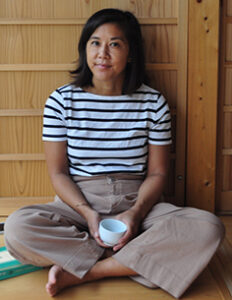
We spent time with Maya Santos to talk through equitable grantmaking, the role of cultural facilities in building community, and the ways that intersectional, intergenerational approaches can unlock new ways of thinking.
To start, can you share a little bit about your work in community development?
Maya: I manage a grant program at 4Culture, which is a Cultural Development Authority, and public agency of King County, Washington. We fund arts-, culture-, heritage-, and preservation-based projects, which include a full range, from individual artists and public art to landmark preservation and cultural facilities. My grant program is called Building for Equity. It’s all about helping organizations renovate, develop, purchase, and sustain their cultural space while prioritizing historically underserved communities. I also worked for the Seattle Chinatown International District Preservation and Development Authority, on affordable housing and mixed-use tenant improvement. Previously I worked on launching +LAB, an initiative focused on integrating creative strategies in community development work for Little Tokyo Service Center, as part of their ArtPlace America grant. This resulted in ongoing creative place-keeping projects and intergenerational community engagement strategies for the CDC’s work in Historic Little Tokyo Los Angeles.
Cultural institutions are so vital to a community. Our research has clearly demonstrated that a great deal of community development practice is shaped by culture. I’m wondering how you’re thinking about that link between equitable development building up culture and culture building up equitable development?
Maya: We have an Equity in Development and Construction Assessment which is a required part of our Cultural Facilities Grant application. While we are assessing internal and external racial equity centered practices, goals, and plans for organizations, we are also searching for effective tools and practices informed by culture. How are they engaging their community through the development of their project? How are they seeking Minority Business Enterprises or BIPOC-owned service contractors? How are they partnering and collaborating with groups outside of the communities they serve to expand their programs? Effective approaches that organizations take through a cultural facility project are of interest to us so we can share what works with others. There’s a lot of groundwork being laid right now through other equity-focused grant funding resources in King County. It’s starting to get very real in terms of how to translate the cultural value of racial equity in development to broad groups of stakeholders – council members, private funders, or even applicants. For example, strategic partnerships are one of the tools that Building for Equity utilizes to address racial inequities in space. Cultural Facilities Grantees receiving a significant amount of funds are required to provide a unique public benefit which we call a “Cultural Space Contribution” to a BIPOC-led/serving organization. This is a 3-year partnership where the grantee provides free cultural space-use and/or technical support to a partner BIPOC-led/serving organization. The main goal of this partnership is that the grantee is supporting the economic viability of the BIPOC-led/serving partner organization. Together, they are also to collaborate toward a measured racially equitable goal, while the grantee’s staff and leadership receive anti-racist training that includes exploring a new tool or practice for their organization. This is an example of how equitable development practices also build up culture. What becomes of these partnerships within this framework of shared resources and collaboration ultimately benefits us all, culturally speaking.
The challenge is how to translate how important equitable development work is. 4Culture and Building for Equity as a program is lucky to have the funding to explore different ways to get to racially equitable outcomes. For instance, there’s a lot of work to better serve Native and Indigenous communities and incorporate those communities in planning and development of programs or large projects throughout the city. 4Culture is putting work into intentionally understanding our role in that effort by putting meaning and action beyond our Land Acknowledgement. Building for Equity is developing a Native-led Cultural Facilities pilot program, a platform where a Native-led body will be making recommendations on which Native-led Cultural Facility project to fund in King County on an annual basis. This is an exciting development for 4Culture in terms of how this program can support the rematriation of land, and environmental conservation as it intersects with heritage, culture, arts, and preservation for Native communities.
It’s incredibly important to provide dollars towards arts and culture, and think about intersections with things like facilities and land sovereignty. It’s wonderful that you all are taking a step towards that and having it led by a Native body of people who get to then make recommendations for it. I’m wondering if, as you’re doing that kind of intersectional grantmaking or reflecting on your own work as an artistic person, you’re observing ways that arts and culture are being employed to keep whole communities together.
Maya: I guess I have a unique role of being able to work with a variety of types of organizations doing a wide spectrum of community work. Cultural infrastructure is how these organizations survive, at least in terms of having space to do the work they’re doing. For example, conservation-based history, centered in the Land Back movement and in traditional practices of Indigenous and Native peoples, helps us reinterpret our history to see places differently – like learning that our national parks were militarized mechanisms for the dispossession of Native lands. These kinds of critical conversations are helping piece things together, and decolonize the ways we’ve been taught, the ways I’ve been taught. Through building relationships with the people and places actually doing the work, my work to support them is informed. On top of that, it’s truly an amazing feeling to help put funds toward their work! I’m honored to be listening and to be part of those conversations. I get to see how the different sectors can, and do, work together to support a decolonized cultural infrastructure that benefits the whole.
Is there anything you think we should be collectively paying attention to in trying to put forward these intersectional approaches?
Maya: It’s important to have continued intergenerational dialogue around racial justice, racial equity, and anti-racism. It’s easy to have disconnections between work done in the past and work being done now. This work is living and never gets done, and I’m grateful to have elders in my Advisory Committee to lean on and have challenging conversations with. They’ve been in this work way longer than me and have such clarity, wisdom, and passion. They have a keen sense of what things should really look like, and what it takes to see something work. It’s a relationship I want to make stronger in the work that I’m charged with – to make sure the work is informed by the continuum of culture, and not a vacuum. I think it’s easy to talk about inclusivity but what does that really mean if you’re not thinking about what perspectives are missing and to whom does this work even matter? We should always be ready to learn, we should always stay open to improving the work and to drawing new connections.
Maya Santos serves as Program Manager at 4Culture, where she oversees the Building for Equity grant program. Maya is also an architectural designer, and documentary filmmaker specializing in place-based stories.
The interviewee is responding to the findings shared in the Anti-Racist Community Development Research Project, produced with support from Robert Wood Johnson Foundation (RWJF) to increase understanding of structural racism in community development and pathways to racially equitable outcomes that promote health equity. The views expressed in this article do not necessarily reflect the views of RWJF or ThirdSpace Action Lab.
© 2023 Robert Wood Johnson Foundation