
We caught up with Liz Ogbu to discuss safety in design and the need for addressing grief, building trust, and storytelling.
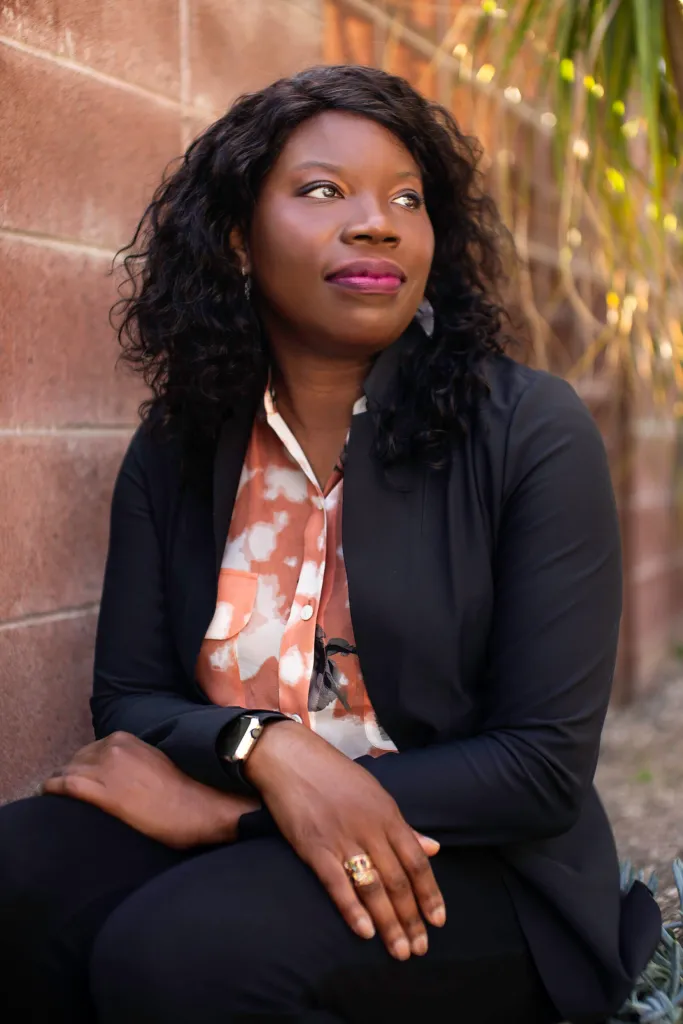
Tell us about yourself and your spatial justice work.
By holding my role as a grief worker or spatial justice activist, I’m making an intention to steward more than what an architect typically does. Spatial justice is the idea that justice has a geography. It requires equitable access to opportunity and resources. We know that those living in unjust geographies are often Black, brown, or poor. It is not possible to achieve justice if space selectively harms people.
The tools of our profession have been used to create harm. While many communities protested highways, the successful protests tended to be in white neighborhoods. Who ended up getting harmed? In Tulsa, the community came together and rebuilt Black Wall Street after the 1921 massacre, in the face of changed building codes subverting their efforts, insurance payments that were not paid out, and banks that refused to give loans. But what destroyed it for good were the two freeways that were sited in that neighborhood 40 years later.
My work is committed to making space part of the conversation about achieving a just future. How do we support communities, as they are building toward a brighter future, and ensure that the spaces they live in contribute to – rather than impede – that future?
Can you share more about your approach and tools you use to remedy this harm?
One example is Kindlewood, a 50-year-old Section 8 development sitting on the site of a former plantation in Charlottesville, Virginia. Piedmont Housing Alliance and National Housing Trust, its nonprofit owners, are working to redevelop it, transforming it into a mixed-income community. Importantly, they’ve committed to doing so with zero displacement and with existing residents serving as co-decisionmakers in shaping its future.
We have to broaden the definition of “client” to include whoever our actions impact. The traditional design process privileges the client who writes the check, so I try to make sure the broader client has equal, or greater, weight in decisionmaking.
We created an advisory group, compensated them, and met monthly. We trained and supported them to make major decisions about the development, from the architects hired to the distribution of income levels. Redeveloping existing low income housing into a mixed-income development can be controversial and feel like an on-ramp to displacement. So early on, I interviewed residents to ask what they wanted to see. Their answers were very rational. For example, they felt living next to market-rate units would provide opportunity, connections for jobs. They wanted to be secure in their homes, but they also wanted access to something better. Our efforts had to be accountable to supporting both outcomes.
I have to create room for residents to be able to dream. Where there has been harm, there can be scarcity. Expansive dreaming feels like a luxury. So we need to ask, what do you need to be able to thrive? That, too, can be part of what we create.
With Kindlewood, we’re not just creating housing. We’re looking at building generational wealth. Educational opportunities. Community belonging.
You said you’re one of the longest tenured in Kindlewood.
It’s been almost ten years, and six more to go. We can’t lock engagement into a tiny phase that happens when we’re figuring out what we want to draw. We’re stepping into places where there has been a long legacy of unfulfilled promises. We need the full participation of the folks who have been harmed and who we want to see as the ultimate beneficiaries. I may have decades of experience, but I will never be the expert of that place. It is my responsibility to connect with the people who are and to learn from them so I can support them to be fully in the process.
I am willing to listen, to hear their hurt. I acknowledge their pain. I hold space for them as human beings. In group situations, I hold space for grief, not moving to the speed of an arbitrary timeline. We were working on a community vision for a decommissioned stretch of a highway in Akron when Jayland Walker was killed horrifically in a police shooting. We had milestones to meet, but people were grieving. I had already heard repeatedly that the highway, the Innerbelt, was just one piece in a long history of not being valued. So I held a grief ritual. That bonded us more as a group, and the community could be in a deeper relationship with one another.
One of the narratives we talk about is the Blank Slate Narrative, the idea of cultural erasure and building without acknowledging past histories or harm. How do you address this false narrative, and what new narratives are you pulling forward?
I think most people have good intentions. But starting as if this is point zero feels harmful to community members who remember the past. If you erase part of my story, how can I trust you to hold any of my story? In Akron, most people hadn’t talked about what had happened for 50 years. For some residents, that land was a highway, a way to get to work, and for some residents, it was a home that had been taken from them and destroyed. We couldn’t have a community-wide vision without a common understanding of the context that we were planning from.
Story-collecting and storytelling were key to this. Stories enable us to create better, holistic community visions centered on healing and thriving, and not just the built object. I want to make sure the ones who experience a loss are the authors of their stories.
The new narratives are rooted in storytelling of the people who have experienced them.
Right. And how are we creating processes so that people can dream of what might be a safe community, where they feel belonging? Part of taking time to build relationships is making sure we are creating a safe place in which to both articulate your hurts and desires, and to establish a framework for collective dreaming. Safety is not only about feeling like we’ve created a place where you can be supported to live your best life; it is also about the process to get to that vision. There needs to be collective care and accountability, so that even when things don’t work, people can move towards repair.
What are some other promising practices that are making you excited about the field?
So many issues are comingled. Spatial injustice is also about economic injustice, environmental and climate injustice, and so on. Also, how are we weaving trauma-informed and grief-engaged practices into our processes? I’m inspired by groups like The Embodiment Institute that look at trauma within communities of color, and share tools to learn about and tend to the embodied experience of it. Sue Mobley and her team at Monument Lab’s Re:Generation project support community
A designer, spatial justice activist, and grief worker, Liz Ogbu is an expert on engaging and transforming unjust urban environments. Her multidisciplinary design practice, Studio O, operates at the intersection of racial and spatial justice. Among her honors, she’s a TEDWomen speaker, Aspen Ideas Festival Scholar, and Rockefeller Foundation Bellagio Center Fellow.